
The Buzz: Kick-start Your Improvement

 – 

The Myths and Facts of Getting Good Fast

When any dancer decides they would like to pursue Lindy Hop more seriously they inevitably want to “get good” really quickly, and through this desire many people fall prey to comparing themselves to other dancers. The fact of the matter is that some people learn faster than others; I would like to help give you a boost by dispelling some of the myths and half truths of fast improvement and give you a couple tips on how to jump start your own improvement.

.

#1 Trained dancers have a big advantage

The most common misconception I hear is that prior dance experience/training gives people a huge leg up – this is only partially true. Trained dancers tend to have greater body awareness than the average Joe, this combined with an attention to performance aesthetic makes a dancer who looks like they really know what they are doing when they first pick up lindy hop. The truth is most trained dance skills do not translate well to lindy hop and in most cases makes it much more difficult to learn social dance skills. To be perfectly honest I find the people who pick up the dance quickest tend to be people with sports or martial arts backgrounds. So keep on punchin’.
.

#2 I need to take all the classes!

This is another half truth, yes you should take lots of classes, but if you are not practicing (social dancing) all these classes can actually drag your rate of improvement down greatly. The solution is to practice a lot while taking your classes – social dancing is the most valuable form of practice there is. This brings me to…
.

#3 I need a dance partner to practice

This is a total myth. If you are smart about how you work on your dancing, you really do not need much in the way of dedicated practice time with a partner in order to improve. Use the time before and after classes to work out whatever is on your mind with a class mate. Also you can take a dance or two when you are out social dancing to work on your stuff, avoid doing this the whole night thought. After all, all work and no play makes… well you get the idea.
.

#4 Some people just have “it”

The old question of natural ability. The thing to remember is that everyone has their own unique aptitudes, some are simply more obvious than others. Try not to compare yourself – you have no idea where people are coming from or what prior experience they may have – focus instead on playing to your own strengths and managing your weaknesses. We all have them after all.
.

#5 What are they doing that I am not?

Not so much a myth but definitely worth talking about. There is a simple answer to this question: they are putting in the hours. People who improve quickly are putting in more dance hours. Everyone has different levels of commitment but if you put in 1000 hours over 1 or 10 years  the rate of improvement will be the same hour for hour. This may be the greatest misconception of them all, that the number of years or the period of time that you have been dancing counts for something – quite frankly it does not – only the accumulated hours you have danced make the difference.

So the big question you are probably asking yourself is “how do I up my improvement?” Here are a couple of tips:
.
  1. Social dance, social dance, social dance!
    .
  2. Put in the hours – be they in classes, practicing, or social dancing there is no substitute
    .
  3. Practice smart – figure out what you need/want to work on and be dedicated in getting it where you want it to be
    .
  4. Diagnose your strengths and weaknesses – a teacher or friend can help with this
    .
  5. Write it down – keep a “Lindy Journal” of what you did in class, or make a cheat sheet of the things you are focusing on and consult it every time you dance
    .
  6. Think and talk about it – think about or discuss lindy hop every chance you get, dancing is not just a physical practice it is really important to get other people’s opinions on it, so geek out hardcore!
    .
  7. Set some goals – once you figure out what you need to work on set some goals so you have something to shoot for
    .
  8. Teach someone – there is no better way to boost your understanding of the dance than trying to pass on your knowledge even if you do not yet know that much yet


Kevin_Bees-Knees-Dance-Teacher_sm-168x168

Kevin Miller
The Buzz Blogger


The Buzz: Getting Started as a Swing DJ

When I started DJing for swing dancers I was pretty nervous. Like most beginner DJs I worried that I’d play a song and the dancefloor would clear. At a swing dance, all attention is on the music and if it isn’t right, it’s your fault as a DJ. It feels like a strangely vulnerable position to put yourself in when you start out. So why on earth would anyone want to do that? Especially when you could be dancing instead of sitting behind a computer?

DJing sometimes feels like dancing vicariously. When dancing with a partner, you have a direct influence on the experiences and emotions of that other person. Any swing dancer will understand how rewarding the experience of social dancing is in spite of any fear of being judged at the beginning. I think the same applies to DJing, except that you have a direct influence on a crowd of dancers at any given time. You can probably imagine how rewarding it is to see how your choices of music affect the group as a whole — or even just that one friend you’re watching, who then comes up to you gasping for air saying, “You’re playing all my favorite songs! You’re killing me! I can’t stop dancing.”

But where do you start? Well, there are some obvious things I could tell you, like: get a lot of music… swing music, and find a place to play. But there are some less obvious things I’d like to share with you that will kickstart your DJing.

First: Observe and learn. Sure, DJing is about playing music, but I think it’s equally about paying attention and understanding who you’re playing for. This brings me to my Golden Rule of DJing: Play for everybody but yourself.

I’m NOT saying you should play music you don’t personally enjoy. I’m saying that your job as a DJ is to find out and play what the crowd wants (even if they themselves don’t know what they want). Be cautious about using your own tastes as a reference. You’re not the one dancing, you’ve been sitting at your computer. You also may not be the “average” dancer in the crowd you’re playing for…

Let’s read that Golden Rule again: “Play for everybody…” When I’m DJing, I only spend half my time looking at the people dancing. They’re happy for the most part. I spend the rest of the time looking at who isn’t dancing asking myself, “Why aren’t they dancing?”, “What song could get him to dance?”, “Is she enjoying that conversation, or resorting to it because she’s a beginner and the music is too fast?”, “Are they not dancing because they’re bored?”, “Are they not dancing because they’re tired?”

With the Golden Rule out of the way, let’s get into specifics. I’ve seen many beginner DJs start from a place of loving jazz music, and probably having a collection of songs they like. But you need to really get a good understanding of two things to be a good DJ. Understand swing music, and understand swing dance culture.  If you just graduated from a music degree, played in your school swing band, bought the entire Ken Burns Jazz collection, and you’ve got your “rock-step triple step” down, that doesn’t make you a good DJ. Knowledge of jazz music theory, and having a large collection of mp3s, isn’t sufficient (to be honest, it’s probably not really necessary to start either). Spend time thinking about:

  • what makes a good birthday jam song?
  • what song could you play that would almost for sure fill an empty dance floor?
  • are you prepared if someone wants to do a Shim Sham? Tranky Doo? Big Apple?
  • if the dance is filled with beginner dancers that just learned lindy hop, what do you play for the first hour? What if those beginners just learned charleston? Balboa?


These aren’t rhetorical questions. They have answers, although the answers may differ from DJ to DJ. As you gain more experience you may develop your own answers to these questions, but in the mean time, here are mine.

What makes a good birthday jam song?

The speed of the song will depend on who’s birthday it is… but in general you want something uplifting that sounds good to clap to… because people will be clapping. You probably don’t want to go too fast, even if all of the advanced dancers were born this month. The song shouldn’t have any abrupt tempo changes either. Here are some examples:

Birthday Jam Songs by Jasper on Grooveshark


What song could you play that would almost for sure fill an empty dance floor?

Again, it depends who’s dancing. If I’m DJing for the local university swing club (UT-Swing), I might put on something like Jump, Jive an’ Wail. If the crowd is mixed I’ll play something like Splanky… everybody loves that song, or C Jam Blues. If there are a good number of experienced dancers I’ll play T’aint What You Do and start a shim sham… and follow it up with something equally upbeat. Notice that none of these songs are very fast… because a crowd of sitting dancers will never jump up to dance to Jumping at the Woodside.

Circumstantial Floor Fillers by Jasper on Grooveshark


Are you prepared if someone wants to do a Shim Sham? Tranky Doo? Big Apple?

Well… I am. These are all mob dances. The songs used for them may very between swing scenes so make sure you have ones that will work within your swing scene. Here are some that I use in Toronto.

Mob Dances by Jasper on Grooveshark


If the dance is filled with beginner dancers that just learned lindy hop, what do you play for the first hour? What if those beginners just learned charleston? Balboa?

If I’m playing the first set right after a beginner lesson, first of all, I’m going to try to be at least five minutes early so I can catch the end of the beginner lesson and hear what the teachers were using for their lesson. The tempo of the last song they play is what I’ll try to match. Here’s where it gets tricky. Sure, there are really slow swing songs… but if you’re trying to get a bunch of (potentially) timid beginners dancing, it’s got to be a good song too. Once I establish the comfort level I’ll slowly try to boost the speed. If the beginners are excited about this new skill, this will be easy. Sometimes, i just need to stay at a low tempo.

The same thing applies to charleston and balboa, but the songs will be different to accommodate these different styles. (eg: I wouldn’t play splanky for a class that just learned charleston). Here are sets of three songs that I might play after a beginner lesson for Lindy, Charleston, and Balboa.

Beginner Friendly by Jasper on Grooveshark


Hopefully that’ll give you some things to think about, and directions to look for building your library… So, let’s talk about the jitters. If you’re nervous about starting to DJ, there are some things you should keep in mind. You don’t have to dive into the deep end right away. You can DJ at low-key events, and maybe even just a small set of 15 minutes. Ask an established DJ if you could take over 15 minutes of one of their sets as a starter. Maybe go earlier in the evening so you don’t need to worry about all your songs being played before you have a chance. That also gives you the added benefit of someone to take over if anything goes awry.

If you’re worried about the dance floor clearing… well… it happens. Sometimes it’s the song, but sometimes everyone just decides to take a break at the same time. Don’t be discouraged when it happens, because the opposite is equally possible. Some other night, everyone may decide to dance their faces off to your music. And for that one night, you’ll be a hero…

…or something. Just have fun and don’t worry.

.

Jasper Palfree
The Buzz Blogger

The Buzz: Putting Toronto on the Map

 – 

A How-to guide for self-coached teams

Since late 2013, I have had the pleasure to work with a group of fabulous dancers in the troupe That Swing! Many of us felt that working towards a big goal would help push our dancing and to help us to develop as a team. No one from our city had ever taken a team to the International Lindy Hop Championships (ILHC), but I had attended in 2012 and loved the atmosphere: The energy was high, the social dance floor was full, and the competition was fierce but the competitors were supportive. I was overwhelmed with happiness when the group took my suggestion seriously, and we decided to compete!

.
What we were up against

We knew that by taking our team to this event, we would be up against international professional dancers as well as teams with years of competition experience. Here are a few fun stats about That Swing!

1)      No one on our team had ever done a team Lindy Hop competition

2)      Some team members had never participated in a Lindy Hop competition; others had their first competition experience at either O’Town Showdown 2014 or Montreal Swing Riot 2014 (links).

3)      Only one team member had ever attended ILHC

4)      We didn’t have a coach or a studio

Basically… we were kind of new at this! But we were determined to combine our strengths to overcome our lack of experience with this type of competition. We thought that there may be other dancers out there in a similar situation, so we thought that we would share the process we used to democratically create and rehearse a choreographed number.

.
How we did it

Choosing the song:

To choose a song, we all threw song ideas into the mix, then had a meeting where we listened to the songs, danced socially to them, and discussed various pros and cons.  We took a vote among our favourites, and unanimously chose: Focus Pocus, from the new Glenn Crytzer album!

Shaping the structure:

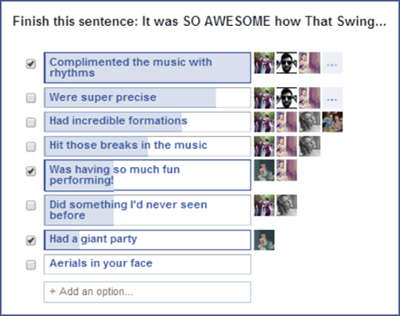
Mandi Gould, the founder of Bees’ Knees Dance and a very experienced choreographer, once told me that audiences (and judges) will only remember two to three things about a routine. If we could decide what we wanted those things to be, we could choreograph to highlight them. We watched some of our favourite routines from past years, and tried to articulate what was so great about them. We set up a facebook poll to help us decide as a group what we wanted our routine to be remembered for:

It looks like a rhythmic, super precise routine with incredible formations was in order! With that in mind, we assigned two dancers with different perspectives to map out the sections of the song, and to make an over-arching plan of what the routine would look like. I contributed my years of Lindy Hop choreography experience to this task, and Kris Light contributed her perspective from years of writing choreography for modern jazz, tap, and musical theatre routines.

Getting down to it

With a map in place, partners or individuals chose sections that they were particularly excited about, and we split up to work on the choreography. We asked everyone to roughly choreograph, but to be open to suggestions from the rest of the group and to be open to having their choreography changed to fit the overall flow. We then took turns presenting our choreography to the group, and working as a team to clarify spacing and make stylistic choices.

I’m not going to lie – there were some tough choices to be made through this process. Handing choreography that you worked on over to a group to critique and change can be hard on the ego, and I could write an entire blog post on the challenges of incorporating the opinions of eight equally talented and invested dancers. Overall, though, we felt that the diversity among our choreographers/dancers was a huge asset to the final product.

The fine print

Yaaay, we had a routine! But there was still a lot of work to do. With two months to go before ILHC, we invited three fantastic Toronto coaches to help us. Caitlin Wellman  helped us “bring out the Lindy Hop” in the routine by suggesting that we remove some breaks to make the routine flow better, and gave us some invaluable advice for competing under pressure. Jasper Palfree has a great eye for effect, and helped us to bring out some of the character in our routine. Arthur Lulu helped us to drill our basics, grounding the more creative/non-traditional aspects of our routine in good technique. A huge thank you to our guest coaches!

In our final practices, we would often watch a recording of a run-through from the practice before, and work as a group to make notes. We would then run through our list, improving, clarifying, and adding styling to each section in an iterative process. The goal was always to take the “worst” section of the routine, and work on it until it was the best section. Another technique that worked well for us was to video tape a section, then choose a couple who looked particularly good doing it. We could then use them as a model, and match the style to theirs.

.

The Result

In some ways the time flew, in other ways it felt like we’d been working on the number forever. But August 20 rolled around, and we packed our bags and headed to Washington! Here is the final product.

We are extremely proud, and would like to extend the hugest thank you possible to our coaches, family, friends, and community here in Toronto. And hey – the judges liked it too, and ranked us in third place!

Thinking about choreographing a routine, but don’t have a lot of experience? Feel free to contact us, we would be happy to share in more detail!


Shannon Refvik
The Buzz Blogger


The Buzz: In Depth – The BKD Curriculum

In the months leading up to September the new partnership at the helm of Bees Knees Dance has been all abuzz. From finding our new home(s), to getting the word out, to deciding the new fee structure, we’ve done our best to really maintain what makes BKD an amazing school and introduction to the Swing world while also taking this opportunity to identify ways we could really up the ante.

Well, consider our ante upped. Our new fee structure is going to be full of rewards for the enthusiasts, our communication with the community is going to be more in-depth and consistent (starting with these blog posts), and our online registration is going to be easier and more reliable.

But when it comes to moving forward there’s no conversation more important to us than the curriculum and what we teach. At the end of the day: after all the business, number crunching and promotion, teaching is what we love, what we’re best at, and what we’re here to do.

The meeting on curriculum became our longest meeting to date at a whopping 7 hours (and the topic still requires more meetings to really tie it off) and mostly centred around student feedback and how to address it. Above all we’re hearing loud and clear that you guys have really been loving your time with us and learning a lot (we’ve loved our time with you!). We were overwhelmed with the stories of joy and success you have sent us and for that we’re so grateful.

When offered constructive feedback, it often came down to one of two main topics:

1.  The level of students in the class can be disparate:
This can be a real challenge for student and teacher alike. It’s hard to work on a new move if your partner is struggling with some fundamental information from the class or level before. While classes are meant to be a fun learning process without a lot of pressure, we want to make sure that as students reach higher levels they are matched with others who have the same goals for their dancing and face similar challenges. This also helps our teachers get through material more quickly as they don’t need to split their focus between working on the day’s material as well as information from the previous level.

2. The progression of the classes can be confusing or in some higher level classes, seemingly arbitrary.
It feels good to know you’ve improved or learned enough to move on to a new class or level and we want to make sure that experience is always clear. There have been times in the past where a student is held in a level a little longer without a clear reason as to why. This was even more frustrating in higher level classes where there wasn’t really a standardized curriculum. This is something we really want to improve upon in the next iteration of the BKD curriculum by giving you clearer benchmarks among the levels as well as direct feedback on how to take your dancing to the next level (both literally and in the catch phrase sense).

.

DEFINING THE DANCER’S PROGRESSION

To break down how we were going to address these concerns we had to know not just what moves each level would learn, but what kind of dancer we wanted them to be as they progressed. Here’s a glance at what we came up with:

LEVEL 1

A level 1 dancer is just beginning their journey and is probably completely new to Lindy Hop. They are ready to learn the basic shapes, the basics of lead and follow and how to connect the moves they’re learning with simple transitions. They’re new to the music and the movement when they come to us, but when they progress to 1.5 they should be able able to dance through an entire song as well as be familiar with all the basic shapes and vernacular.
You kind of know you don’t have your sea legs yet, but you’re having too much fun to care. Being at social dances is overwhelming but also surreal and cool. You’re not sure which friends to tell you’re trying this out.

LEVEL 1.5

We thought it was really important to keep a 1.5 level (there was discussion about making the levels go 1, 2, 3..) because after level 1 you’re just starting to get good at the basic shapes, the core movement that is so important to this dance. A 1.5 dancer is learning to not just step where they’re supposed to but to look and feel like a swing dancer. Their focus is to strengthen their basics and their transitions, learning to really own the concept of social dancing’s ‘lead and follow’. Before moving on, a 1.5 dancer has learned new material and transitions, both in and out of the classroom, and has strong fundamentals in the 3 core disciplines of Lindy Hop: 8 Count, 6 Count and Charleston.
You have probably bought at least a couple of vintage clothing items and now your Saturday night completely belongs to the Dovercourt. Your “normal” friends are giving you weird looks when you bubble over with swing excitement. Swingcitement. ILHC jams are now the videos you watch at work when your boss isn’t around.

LEVEL 2

The level 2 dancer is ready for bigger moves. They have deeper questions about technique and connection and are invested in their own growth outside of the classroom. When a level 2 dancer moves on it’s because their arsenal has grown significantly and they’re obsessed with the perfect swing out and the perfect pulse as well as have delved into the dark arts of The Solo Jazz.
You now own vintage suspenders, think Benny Goodman is the bomb, and just went to your first big dance event. You should see a doctor, because you clearly have the bug. You’re also trying to drag your best friend from the real world into a class. What’s that Balboa thing?

LEVEL 3

The level 3 dancer is nearly ready to lead their own learning and in many ways already are. Fundamentals are more than an obsession and their vocabulary grows every time they watch someone else dance. While there are laughs at this level, it’s more serious and the discussions are longer. They’re also likely dabbling in other styles like Balboa and Tap and solo jazz is being incorporated in their dance in a serious[ly fun] way.
Nina Gilkenson swivels haunt your dreams, you’re trying to get your Frankie biography signed by anyone from that era, and you argue over a pint at Grossman’s over who brought it more: Artie Shaw or Benny Goodman.


WHAT WE’RE GOING TO DO ABOUT IT

With this in mind we’ve developed a more expansive early curriculum with more specific focuses. Now levels 1 and 1.5 will both have a 3 month curriculum. In Lindy Hop 1 (LH 1) one of the months will include 8 count movement like the swing out and lindy circle. Another will focus on 6 count movement such as change of places and the six count pass. The third month will focus on charleston including face to face, side by side, and tandem charleston. In LH 1.5 we will focus on technique, transitions and new variations of the basic shapes from each month.

Before moving on to level 2 you will also be required to do an assessment with your teacher. This will give us an opportunity to touch base in a more personal way and if there is a reason we want you to hold off moving on to level 2 it will be clearly explained in the review. This means no more endlessly cycling through a level without knowing what would get you to the next and also ensures that when you reach that next tier of classes that you are working with dancers at your level. This also introduces you to really direct feedback early on in your development as a dancer, which is invaluable.

Our level 2 classes will be longer still, with a 6 month curriculum* that will now cycle in the same way as the 1 and 1.5 classes always have (a repeating curriculum that can be entered on any month). When moving to level 3 you will be required to complete the same review process as before, which will determine what you should work on to move on, if anything. It should be noted that we also do not believe in the ‘infinite’ curriculum. While we haven’t officially decided on a final level to offer, we do believe that at some point regular classes are not the best way for a dancer to improve and we will be offering private lessons and masterclass workshops for those who have reached that point in their development. We also highly recommend travelling to big dance events (where some of the best dancers in the world gather to teach, both in workshops and private lessons), joining performance troupes and engaging in practice sessions with other dancers at your level.

Above all, these classes should follow the arc of the dancer themselves. Early levels will be about fun and building confidence and vocabulary. As you become more serious about your dancing, so will we, focusing on technique, musicality, styling, and ever more challenging moves and shapes. Our goal is that you come for the fun and you stay for the overwhelming satisfaction of continually growing and learning in the greatest community on the planet: swing dancers.

As always, your feedback here and throughout the process is VERY welcome.

Love, dancing, and music,

Yam

*Tentative, still being discussed.


JAMES EVERETT
THE BUZZ BLOGGER

The Buzz: Look Ma, I’m Doin’ It!

Last edition, Buzz Blogger Kris gave us some insight on coming to Swing Dance with a ballet background. No matter what your dance background is, there are likely to be unique challenges ahead. Here’s my perspective on starting swing dancing as an adult, having never danced a step in my life.

My hips can do WHAT???
I was astounded when I realized that my hips, physically, could move in three dimensions. This wasn’t just me learning a new skill, it was me learning a new fact about the human body. It was like discovering I have gills. I still get a giant kick out of doing the mess’ around for that exact reason.

I have to move my ARMS too???
Lindy Hop classes tend to focus on how well you’re connected to your partner, and on how your feet are moving across the floor. There are a lot of Lindy Hoppers out there who have worked really hard on those concepts, and are great social dancers, but find that getting that last limb involved is the trickiest part… I am one of those dancers, I feel your pain!

K, got the shoes, and the tights, and the water bottle, and the snacks, and the kitchen sink…
Yikes! Never in my life has going out socializing required so much stuff. Indoor shoes. Dance shorts for under your dress. Extra t-shirts on warm nights. Tights. Water. Snacks. Mints. In the summer: A fan. In some cases: costumes. No wonder I leave my stuff all over the place! I guess it’s not as much as some sports, but more than your average night hanging out with friends. If dancing is a new hobby for you, remember to pack accordingly! Invest in a stylish, massive, 1940s inspired tote bag (haha good luck).

Those first few classes…
If you’re brand new to dance in general, it might take you a bit longer to master those basic Lindy Hop steps. That’s totally normal – right at the beginning, someone with a lot of dance experience might have an advantage. That said, Lindy Hop has a lot of unique techniques, and you might find some things easier if you don’t have habits from another dance form. Perseverance pays off, there are many amazing dancers who had a rough go of it in their first few weeks.

Look Ma, I’m doing it!
Perseverance pays off, and the feeling of accomplishment you can get from a great social dance is truly amazing. And once you’re out social dancing – you’re a dancer! Try this out – say to yourself “Yup, I’m a dancer”.  Weird eh? I’ve been dancing now for almost nine years, and I still find it a bit surreal to say that out loud. Becoming a dancer (and a dance instructor) was hugely different from anything I ever expected to do with my life, and I still sometimes can’t quite believe it.

Moral of the story is, whether you have a lifetime of dancing under your belt or you’re not quite sure which one is your left foot, there’s a place for you in the Lindy Hop!

Have any experiences you’d like to share? Post in the comments below!


Shannon Refvik
The Buzz Blogger

The Buzz: From Swan Lake to Swing-Outs

Confessions of an Ex-Ballerina  

At a recent solo jazz workshop weekend, I had an interesting experience that has stuck with me and really forced me to think about my Lindy Hop learning style. At this workshop, I was taking part in an individual technique assessment that involved performing an improvised solo jazz set to three different tempos of music while seasoned professionals looked on. When I had finished, one of the pro dancers looked at me and proceeded to summarize my entire dance training history deduced entirely from the intricate details he saw in my styling.

That was when it became abundantly clear to me… you can take the girl out of the tutu, but that darned tutu will just keep on poofing itself all over your Lindy Hop.

I won’t lie, having 30+ years of dance experience before making the leap to Lindy Hop has had its advantages, such as a comfort level with musicality, acute body awareness, and the internal metronome that baffles many a co-dancer. But it hasn’t been without its challenges, and as more and more dance school dropouts migrate over to our wonderfully diverse community, I suspect these oddities will be far more common:

Counting versus Scatting

For me, 5-6-7-8 wasn’t just a preference, it was a necessity. Recreating a syncopated rhythm without knowing exactly which number my weight shifted on caused many of my first Lindy Hop brain explosions. After all, you can’t immediately undo decades of conditioning just because someone scats in your general direction… but eventually you can. And it’s soooooo worth it.

Pulse?

What the what now? You want me to bob up and down while keeping my body low throughout my turns? Throughout everything? That can’t look right. That can’t possibly help me maintain balance. That can’t possibly… oh wait… fine, you win this round, Lindy Hop. Finding (and maintaining) my dance pulse was so foreign early on that I had to do it consciously for the entire first year of my Lindy Hop life. I studied many dance styles before this and none of them were based around the pulse concept, but it fits perfectly within Lindy Hop. I think I drove my first instructors nuts in the early days by constantly trying to smooth out my swing outs…

Breaking Up with Back Leading

I was used to being solely responsible for my own dance experience, my own performance level, my own competition prowess, my own fun. The idea of sharing that with another person or *gasp* letting them hold the reigns took a lot of head shaking. I would practice sequences alone, confident of where I’d step my feet and which direction I’d dance in, regardless of what was led. Sincere apologies to my early dance partners. Oh heck, current ones too.

You Dance in Jeans?!

The Lindy Hop community has a wonderfully relaxed attitude when it comes to rehearsal attire. Show up in whatever you wore to work, or what you plan to sleep in, or your vintage best. Anything goes. I love that, but it’s also weird. How do you dance in something that restricts your freedom of movement? I don’t get it. Therefore, I’ve been repeatedly asked to explain the reasoning behind my rehearsal tights, ankle warmers, or split-sole shoes. And I’ll happily keep explaining. Diff’rent strokes for diff’rent folks!

Unintentional Turn-Out

And unintentional pointed feet. And unintentional head spotting during turns. And unintentional port de bras hands. And unintentional releve. All. The. Time. These things took a long time to get to second nature, they take a long time to reprogram. Or not. I finally stopped pointing my feet in basic side-by-side Charleston but I can’t promise the end of pretty hands in a swing out.

Those Aren’t Narcissistic Fantasies

I love dance studio mirrors. I stare in them constantly. No I’m not that self-obsessed. But how can you know what to improve with your dancing if you don’t know what you look like? How low are your swivels? How clear is your Camel Walk? This brings up a whole social-dance-versus-performance derailment that could be a blog all to itself, but suffice to say I use the mirrors.

Performance Face

Just deal with it. Or submit yet another goofy photo of me to #LindyFace. S’all good. I’ve decided to own it. If yer a-watchin’, I’m a-performin’. It’s natural, like breathing. Yup, I laugh at videos of myself too. It’s goofy. But it’s me.

.

These are of course just my personal experiences and observations, most of which have been greeted with an enthusiastic “oh gosh me too!” by other bunheads when we realize we’re not the only weird ones who took forever to absorb the concept of connection.

Are you an ex-pat of the pitter pat world as well? I’d love to hear your experiences with transitioning to Lindy Hop! Share your thoughts in the comments below. And who knows? You may just help another NewBee navigate these strange waters and discover the amazing freedom and joy that this dance can bring!


KRIS LIGHT
THE BUZZ BLOGGER


The Buzz: Out of Town Event$ – Tips for Traveling on a Shoestring Budget

Workshops! Dance camps! Exchanges! Competitions!

Travelling for dance can be a great way to meet new people, accelerate your learning, and improve your dancing.

It can also be expensive. Registration fees, transportation, accommodations, and food can add up fast. Here are some useful tips to help you get out of town without breaking the bank.

.

1. Stay Closer to Home…

If you live in a city that’s fairly close to other swing dance scenes, you can reap all the benefits of traveling for dance without having to go very far. From Toronto it’s not far to Montreal, Ottawa, Kingston, Waterloo, Hamilton, Buffalo, or Rochester. You won’t have to spend as much on transportation and if you’re going somewhere close to home you might not have to stay over for more than one night, if at all, saving you money on accommodations when free options aren’t available.

…But if You Can’t

If you don’t live anywhere near another swing dance scene or if you want to attend special events that are not close to home, there are still ways to save a few dollars. It takes a lot of work to run an event and organizers are sometimes willing to let people trade volunteer work for discounts, free classes, or even full registration. Contact the organizers well in advance.

.

2. Avoid Air-Travel…

Flying is so much faster than ground travel, but you’ll pay a premium for the convenience. If you’ve got the flexibility in your schedule, take your time getting to and from events. Rent a car and split the cost with several other dancers or, even better, find someone who owns a car and have everyone chip in for gas. Megabus is another great option if you can be flexible about your departure times, and if you book your seats early enough the tickets can be extremely cheap.

…But if You Can’t

If you’re travelling a long distance, maybe overseas, or if you just don’t have enough time to spend hours and hours getting to your destination then you might have to fly. Just be sure to get the best price you can. Some airlines offer great discounts at certain times of the year. Get to know when these sales happen so you’re ready to take advantage.

Also, these days a lot of carriers charge a fee for checked baggage so if you can avoid checking any bags and travel with only carry-on luggage you’ll probably save yourself about $50.

3. Couchsurf For Free!…

The more you travel, the more you’ll get to know people in other cities, the more options you may have for places to stay. Ask around to see if your friends have a spare bed, a couch, or some floor space where you can crash. Let’s be honest, how much time are you really going to spend sleeping anyway? Some events even have a billeting coordinator to match up out of town guests with locals who have space to spare. Get in touch with the organizers!

…But if You Can’t

If staying with locals for free isn’t an option there are other ways to save. Get a group together and share a rental through AirBnB. You’ll likely pay less than hotel rates and you’ll have access to a kitchen so you can save money on food too. Bonus!

No AirBnB where you’re going? If you have to stay in a hotel, share the cost with as many people as you’re comfortable fitting in one room. If you’re not going with a group, see if there are others who are looking to fill a spot in their room, or who would be willing to let you chip in to sleep on a cot or the floor.

.

4. Avoid Restaurants as Much as Possible…

When you’re traveling it can be hard not to spend all your cash on eating out but if you can minimize restaurant meals you can maximise savings.

Start by bringing some of your own food from home. Foods that travel well and can give you a much-needed energy boost are best: granola bars, peanut butter, fresh and/or dry fruit, crackers, nuts, etc. Just be careful about restrictions if you’re crossing international borders; there are some foods you are not allowed to bring to the US from Canada, like citrus fruits and Kinder Eggs. Check before you pack to avoid delays at border security.

If you’re staying with friends or at an AirBnB you can save by making meals at your home-away-from-home. Find the nearest grocery store and make pasta, rice and beans, or a stir-fry. Even if you’re staying in a hotel, you can get a few things eat in the morning to avoid pricey restaurant breakfasts: pick up fruit, Wasa crackers, and nut butter.

…But if You Can’t

If there’s no grocery store in sight or you really just want to eat out once or twice while you’re there, try to find a “food buddy”:  someone who has similar tastes, and dietary restrictions if that’s your situation, who’s willing to split an entree with you. Restaurant portions are often huge so why not share the food and the cost?

.

Travelling out of town for dance doesn’t have to mean going broke. With a little planning and care you can master the art of traveling on a dance-shoestring budget!

Heather O’Shea
The Buzz Blogger


The Buzz: Toronto’s Quest for Gender Neutrality

Happy Pride! In celebration of inclusivity and openness within the swing dance community, here are some of my thoughts on gender roles within swing dancing.

The swing dance community is very supportive of the idea that the dance roles of following and leading are not inherently tied to female and male gender roles. But even with the best intentions, it can be challenging to support this in real life. That’s sort of the whole “point” of internalized ideas – they feel normal and logical until you really shine a light on them. It’s not enough to assume that you are supporting gender diversity within dance unless you take the time to educate yourself, and to critically examine your assumptions and actions.

And hey – even if you have good intentions, and put in that time, we’re all going to run into situations where we don’t know the “right” answer, where we don’t come to the “right” answer in time, or where there is no “right” answer at all. This is *especially* true in swing dancing. We are trying to reproduce a dance that comes from an era with specific expectations attached to gender. We want to be true to the original spirit of the dance… except the gender roles part… guys, this is hard!

I’ve compiled below some “sticky situations” that I’ve come across, where I didn’t exactly know how to handle a situation. Sticky in a good way! Working through tricky situations is how we learn.

Telling stories in choreography
Situation: All of the performers in a choreographed number are dancing the traditional role based on their gender. While choosing outfits for the performance, followers are asked to wear skirts and leaders are asked to wear pants and a vest. Everyone is wearing something that they already own and are comfortable wearing. Easy right? Well, not entirely.  People should be able to choose their dance role without that choice being attached to gender-specific clothing. This came up for me personally at the most recent Bees’ Knees Dance show. In one number, I was leading but wore a dress, as this was the easiest way for me personally to fit in with a “dressy” theme. I didn’t feel pressured to dress “like a man” just because I was leading. Yay! Another number (which I helped to choreograph) had a WWI theme, something along the lines of “a last hurrah before the soldiers head off to war”. This was more difficult to navigate. The leaders were dressed in a military theme. The followers were dressed as “loved ones saying goodbye”. The followers were all women, and all chose to wear dresses. I would have been completely open to a follower choosing a more gender-neutral or “masculine” outfit, but it didn’t come up – and, the choice of dress did help to create the historical picture. Using traditional storylines with traditional gender roles makes it easier to tell stories through dance. One of my personal goals is to tell stories through choreography without attaching dance roles to gender roles.

But they want to be traditional!
Situation: After hearing about leading and following in gender-neutral terms in a beginner lindy hop class, a man chooses the follower role. This is good, as a teacher I’m actively trying to de-emphasize the “normal” role, and to normalize role choice! Yay! However, most of the class has chosen the traditional role based on their gender (maybe they have cultural knowledge suggesting that leaders are men and followers are women). After a few rotations, it “clicks” for the man who is following that he is dancing a non-traditional role. He didn’t actively choose to be “non-traditional.” The hypothetical person in this situation would prefer to dance with women most of the time, and is uncomfortable in the role he has chosen. There are two common outcomes in this situation: the person in question feels uncomfortable and never comes back, or they try to switch roles mid-class causing footwork mayhem. I have some strategies that help in this situation, but whether or not I should give beginners some context about the most common dance role for each gender is something that I’ve never fully resolved.

You don’t know the full story
Situation: During class rotation, one of the leaders refuses to dance with a particular follower. My reaction would be to take the leader in question aside to explain that it is disruptive and unfair to refuse to dance with a particular person in rotation, and give them them the option of re-entering the class or allowing them to leave the class with a full refund. This seems like a clear  solution, but there are things I struggle with. You never know the full story behind personal relationships. Perhaps these individuals had a negative social interaction outside of class, which made the leader in question feel unsafe with this partner.  Maybe there is a dance issue, where the person refusing the dance feels like their partner was rough or somehow dangerous to dance with. I am an advocate for personal space on the social dance floor – I often counsel people that while swing dancing culture involves accepting most dances and dancing with a diversity of people, you never have to accept a dance and that you are always in control of your personal space. In principle, this seems to conflict with my decision to “force” people to dance with  each other in rotation. However, attending a swing dance class means that you are opting in to a situation where you will be rotating partners, and the instructor has a responsibility to create an inclusive environment in the classroom. They also have the responsibility of creating a safe environment – a good instructor will pay careful attention to people’s dancing to correct any behaviours that could be dangerous or uncomfortable. This situation is one where I feel confident about the action that should be taken, but acknowledging that people may have different reasons for refusing to dance with someone can make it challenging to implement.

Some other resources
A lot has been written about the topic of gender and dance roles in swing dancing. I really like the work presented here by Rebecca Brightly, here by Dogpossum and I personally rely on the Safe Space Guidelines written by Toronto’s Swingin’ Out.

Feedback
Thanks for reading! Have something to suggest for my sticky situations? I’d love to hear what you have to say in the comments below.

Shannon_Bees-Knees-Dance-Teacher_sm

Shannon Refvik
The Buzz Blogger

Bees’ Knees Dance closing on Yonge St. & re-locating under new management

Bees’ Knees Dance closing on Yonge St. & re-locating under new management
April 25, 2014 at 9:57am
Dear friends, students & Bees’ Knees family,

It’s with great sadness that I make this important announcement.

Bees’ Knees Dance is closing at 750 Yonge St., and re-locating under new management. We have loved The Hive at 750 Yonge St. but the space is too expensive for us and we will be closing this location at the end of June. Our time here has been a success in most ways, but not financially, so the time has come to move on.

This is not the end of Bees’ Knees Dance, but it’s the end for me. It’s time for some major changes and in addition to downsizing to a more reasonably priced location, I will be stepping down as the school’s Director and passing the torch to our wonderful team of instructors, led by Shannon Refvik, to take Bees’ Knees Dance in a new direction. They are planning great things and you can look forward to hearing their announcements in the coming weeks.

It’s been just under 2 years since moving in to 750 Yonge but since taking possession, things just haven’t gone my way. Within 2 weeks of moving in to the studio we learned that my husband had cancer and those were the hardest 7 months of my life. Not living in the actual city, what I thought would be manageable became very hard and unmanageable for me – running a studio in a city where I don’t actually live. Additionally, my commitment to carrying on Frankie Manning’s legacy through the Frankie Manning Foundation and Frankie 100 distracted me from what I did not want to accept; that The Hive was failing financially.

I toook on too much and spread myself too thin both administratively and emotionally. Maybe I’ve made the wrong decisions along the way but I’ve done my best. Unfortunately, my resources have now run dry. It’s time for me to move on. I guess you could say that I’m retiring, not from Lindy Hop, but from teaching on a regular basis, and from the administrative and financial commitments of operating a dance studio on an ongoing basis.

We will be holding a closing party on Monday, June 30th, which is the night before the Canada Day holiday so you can all sleep in the next day.

I hope that you will join us for our final classes at Yonge & Bloor during May and June and enjoy The Hive as much as possible. We have loved it here and we want to make the most of the space. Please come out and help make our last 2 months the best months ever!

Please stay tuned for more information about future Bees’ Knees plans and about the party.

Thank you for all of the good times and for being a part of our family.

~Mandi

Mandi GouldDirector, Head Dance Instructor

Toronto Star Article: April 15th, 2014

TorontoStarDancers getting into the swing of things

Swing dance aficionados say their numbers in Toronto are growing.

Students at Bees' Knees Dance show their stuff during a swing dance lesson.VIEW 2 PHOTOS
zoom

HENRY CHAN JR. PHOTO

Students at Bees’ Knees Dance show their stuff during a swing dance lesson.

By:  News reporter, Published on Tue Apr 15 2014

Six strangers form a circle in a dance studio above a Yonge-Bloor shoe shop. They exchange some nervous laughs.

“Before we start, what image that comes to mind when you think of swing dancing?” asks Mandi Gould, founder of Bees’ Knees Dance.

Responses vary. A middle-aged man in a suit mentions energy, while a teenager in a T-shirt is excited by jumps and swings.

“You do see some crazy moves with advanced dancers at competitions,” Gould tells the group. “But you’ll see that anyone can do Lindy Hop,” the original form of swing dance.

Gould turns on a Louis Armstrong classic and leads the group through some simple movements. Within minutes, the suited man sways his hips, and a timid woman starts snapping her hands.

The six congregated here are among hundreds of Torontonians who try swing dancing each year. Studios and dance groups have noticed a recent uptick in those who catch the jitterbug.

“I do think it’s become more popular recently,” says Gould. She expanded Bees’ Knees Dance into a permanent, full-time studio in 2012, after sharing a space for three years and renting rooms for 10 years. “More people are entering the scene.”

Related:

Cultural historians believe swing dancing originated in the 1910s across African-American communities. A partnered dance in Harlem called Lindy Hop gained mass media attention in 1927. The fast-paced jazz dance quickly spread across North America, sparking variations like the Charleston and the jitterbug.

Swing dancing gets its name from the variations or “swings” thrown into the rhythms of performed jazz music. Rock and roll took over dance clubs after Second World War. But swing saw a revival in the late ’90s, when movies like Swingers or the Gap’s “khaki swing” commercial brought the style to a mass audience.

“Groups and events have built up a Toronto community since the ’90s,” says Brian Gottheil, who co-founded UT-swing, a University of Toronto club, in 2007. “I think you now see the results of that, together with swing in the media.”

Swing dancing is featured prominently in the recent Great Gatsby remake, and appears in shows like Boardwalk Empire and Dancing with the Stars. Meanwhile, the recent electro-swing genre has DJs combining old recordings with new sounds.

“You do see swing dancing around more in the last few years, but I think it’s really this welcoming community that brings people in,” says UT-swing vice-president Hannah Bild-Enkin. “You get active, you meet people and you can be a total geek about it.”

UTswing has around 60 registered members, and 30 people usually show up for weekly drop-ins — half of whom are students. But the city’s biggest weekly event happens at the Dovercourt House, where Swing Toronto holds a dance every Saturday night.

Shirqille Williams has come with two other U of T students to practice some basic steps. It was the Gatsby movie that originally led her to UT-swing, and now the Dovercourt House.

“I really like the dance; it’s a lot of fun and you feel like you’re going back to the 1920s, which is really glamorous,” she says.

For an hour, 50 strangers are paired together to learn or practice a sequence of standard moves. When dancing, these moves can be repeated and mixed.

By 10 p.m., training’s over and the regulars arrive, some wearing top hats, suspenders or ball gowns. A live band serenades the crowd with trumpets and a bass violin.

“We’ve seen more people coming out on Saturdays over the past five years,” says Simon Threlkeld, who leads Swing Toronto. He estimates a hundred people attend each Saturday’s dance, with about 50 more for occasional competitions.

Scattered across the thumping floor, a handful of people wear red T-shirts marked “dance ambassador.” The non-profit group Toronto Lindy Hop sends volunteers to the city’s events to help beginners perfect their technique.

“Swing dance is collaborative,” says Threlkeld, peering across the dancefloor. Experienced couples chop their feet, while giggling beginners twirl back and forth.

“It makes it a lot of fun.”